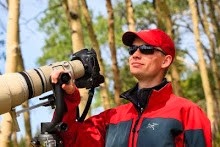
Axel celebrates a successful climb atop Rock Creek Falls in the Beartooth Mountains, outside of Red Lodge, Montana. Captured with a Canon 7D and 70-200/2.8L IS II + 1.4TC III in aperture priority mode with an exposure bias of + 5/3 at ISO400, f/5.6, and 1/200th of a second. The camera was handheld.
PHOTOS ONLINE
Work sent me on an ice climbing trip to Rock Creek Falls in the Beartooth Mountains, outside of Red Lodge, Montana. They sent me to photograph a student, climber, for an upcoming magazine feature...I really do have a great life/job.
For photographers the problem with photographing climbing trips is that you have to both climb and shoot...that means that you are carrying both climbing gear and all of your needed gear to shoot the climb. I chose to suffer under a heavy load to bring with me the gear to shoot both portraits and the action of climbing. If my 5DIII had come in at the time I might have decided to pack a little lighter, and thus the approach and climb would have been much easier. I ended up using everything from 17mm on a 5DII to a 400mm on a 7D.
Having more experience than many of the student climbers let me haul a heavy load around with more ease than the student climbers who were carrying little to no gear, some of the leaders had heavy loads too, and the approach killed them :)
I hope to tag along next year with the ability to shoot, for the sake of shooting, rather than shooting with a specific feature in mind...next year.
Make the jump to go through the online gallery, I ask that you leave comments/criticism or at least give your favorites a thumbs up...Thanks!
If you have questions, ask. I published the camera information with each image and have added full keywords to share just about anything you would want to know about the images.
Happy shooting
Showing posts with label Rocky Mountain College. Show all posts
April 8, 2012
February 9, 2012
Teaching...
Most of you know that I teach photography half time at Rocky Mountain College, where I am also the staff photographer. What keeps me happy with my job is the ability to spend time teaching, both art majors and non-majors, photography. I teach 200/300/400 level courses and each course brings a new group of students and challenges, but we all know that challenges bring opportunity.
Last semester I instructed an ART247 course titled Digital Nature Photography, although it is a 200 level course that tends to fill with non-majors it is my favorite course to teach. The subject matter is what I spend most of my free time doing, and Albert Einstein said it best “If you can't explain it simply, you don't understand it well enough.” Teaching what I love most to people who may be learning how to use a camera for the first time is challenging, but extremely rewarding. Last semester I structured the class a little different than I had in the past, and it felt as though I was not getting my message through to the students. It was a great surprise when the students made their final presentations of the semester's images and they had great works to show, and an excellent understanding of what/how they made the works. It was even more affirming when I received my course evaluations from that class. The course averaged 4.7 "excellent course" and my average was a 4.5 "excellent teacher" (five is the top score) . Those numbers put a smile on my face, but what I found most rewarding is that two students (evaluations are anonymous) commented that, because of this course they found a new hobby, and for a class of non-majors that is all I could ever hope for.
I also instructed a 400 level travel photography course, but that can't compare ;)
I make myself read these quotes frequently, so that I can stay out of my students way and in doing so be the best "teacher" I know how to be.
- "There are many teachers who could ruin you. Before you know it you could be a pale copy of this teacher or that teacher. You have to evolve on your own." - Berenice Abbott
- "Experience is the best teacher of all. And for that, there are no guarantees that one will become an artist. Only the journey matters." - Harry Callahan
- "I don't think there's any such thing as teaching people photography, other than influencing them a little. People have to be their own learners." - Imogen Cunningham
April 21, 2011
Ask Dave, April 21st - Churchill 2011
Ask Dave, April 21st
'Ask Dave' week ten… I get tons of questions each week, I respond as quickly as possible, and this is week number ten of answering them here too. If you have questions you can email me at Learn@DaveShumway.com.
Question:
From Pete...
Can I go with you to Churchill in the fall?
Answer:
YES you can...
I am going to Churchill with Dr. Jim Halfpenny, Professor Kayhan Ostovar, and some college students in October of 2011 to photograph Polar Bears, Snowy Owls, Arctic Fox, and more. *
I am not leading the trip, I am not being paid to go, I am actually paying to attend and paying to earn college credit on the trip (you never know when having a few extra Environmental Science credits will come in handy). The cool thing is that you can all go too.
There are thirteen spots total and a handful left open for auditors.
All of the details are on the RMC site:
http://rocky.edu/academics/programs/environmental/Churchill.shtml
Here are some of the key details:
October 12th - 18th, 2011
We will spend 4 days on the tundra, in vans, not the big, crowded, buggies.
We live at the research center, studying and photographing bears each day with lectures each evening.
Cost for RMC students is $2980
Cost for auditors is $3400 (this includes a private room en-route to Winnipeg)**
Initial deposit of $500 due April 30th. (I know that is coming soon)
Final payment due August 1st.
Travel insurance is required and can be purchased from Rocky for $13.50 (this is not trip cancellation insurance).
* (Hopefully all of them each day; but RMC and Dr. Jim Halfpenny would like to stress that polar bears are never a guarantee :)
** Auditors must also pay the standard course audit fee of $105, or $62 if you are over 60 years old.
As the RMC site says:
"RMC staff photographer and instructor of photography, Dave Shumway, will be joining the trip as a member of the class, so there will be chances for some photography instruction (when the teacher in him outshines the photographer in him)."
I really like the Naturescapes.net article about Churchill trips.
Labels:
2011,
Ask Dave,
Bears,
Churchill,
Dave M. Shumway,
Dave Shumway,
Fall,
October,
Photography,
Polar,
RMC,
Rocky Mountain College
January 13, 2011
Articles for ART347
I have decided that from time to time I am going to share links to articles that my ART347 students are required to read and discuss. My students will be blogging their thoughts and questions on their own blogs, that can be found here.
The first four articles are a series of articles on composition by Fine Art Landscape Photographer Alain Briot written for the Nature Photographers Network.
As the semester has just begun this first round is more of a refresher/warm-up for the class; but is still a good series of articles for us to all read and then examine our process' from time to time. "The Traditional Rules of Composition (part 1)" and "The Traditional Rules of Composition (part 2)" are both excellent examinations of the basic rules/types of composition and different ways to control composition, and by extension our images viewer. Most of what is written one should already know and follow, weather done consciously or not is another issue.
The second two articles relate more to composition in terms of its use in "Fine Art" or "Vernacular" photography. "Fine Art Composition" and "What Is A Snapshot" both examine composition as it relates to the respective type of photography.
I hope that you can take something away from these articles. If you have questions do not hesitate to write or call me, as I'll be happy to share my take and what the students in my ART347 course come up with.
November 24, 2010
When I was new to Montana...
Canon Pro1 at 32mm, aperture priority mode set at f/5.6, ISO50, and 1/400th of a second. Exposure bias of -1/3, shot handheld while on a hiking trip. Captured in JPG :(
THE IMAGE IS ONLINE HERE
I came to Montana in the end of August 2005, and I lead this hiking trip for Rocky Mountain College's Outdoor Recreation program to Quinnebaugh Meadows near Red Lodge, Mont. on the 18th of September (three weeks later). Trips to the Red Lodge area are amazing and more often than not I decide to take less photos, so I can experience the beauty of nature for myself and not through a camera's viewfinder. This is another image that looks much better after being edited with new software and what I now know about editing 5 years later.
October 11, 2010
Yellowstone October 9th & 10th
PHOTOS NOW ONLINE
"WOW! This is Yellowstone, why have I lived here 6 years and never visited before?"
"I could not imagine a better visit to the park."
"I see why you love this place, and how it could never get old."
Those are just some of the things said by students after this great little two day trip to paradise, the granddaddy of all national parks: Yellowstone National Park.
We left Billings, Mont. and the campus of Rocky Mountain College a little before 5:30 a.m. Saturday, Oct. 9. Due to nearly nine inches of snowfall on the Beartooth Pass the evening before we had to take the "long" drive to the Park's north entrance in Gardiner via I-90 and Livingston. Arriving at the park to a very cloudy 8:00 a.m. start we got to work on the point of the trip, taking photographs.
We headed south all the way out to West Yellowstone for lunch with only a few photo stops along the way (Nice light on Swan Lake, Bison, Chocolate springs, Elk, etc.). After a quick lunch we were headed back in and south to Castle Geyser, but progress was slow with stops to shoot a Bald Eagle, Trumpeter Swan, Great Blue Heron, more Elk, and autumn vistas.
This was our second consecutive class trip.
We arrived to Castle Geyser blasting off and then spent some time spent shooting around the area. At this point we needed to head back toward Gardiner as the general consensus was that we wanted to spend some time in the boiling river, but the park had better plans for us.
As we drove north we had the pleasure of sighting a Grizzly relatively near the road and were able to photograph it for some time before it crossed the Gibbons River and headed up the opposite hillside. At this point the students were more than OK with not making it to the boiling river, and their "great" trip had begun. The day finished off with a sunset shoot atop the upper terraces, then off to the Super 8 to get checked in, then K-Bar for some great pizza and conversation.
I was the "bad guy" who ordered 5:15 a.m. wake-up calls for every room so we could have breakfast at 6:00 a.m. and be on the road at 6:25 a.m. With Moose and Black Bears on the top of my students list we were off for the drive to Petrified Tree, with no luck on Moose nor great color at sunrise. I was starting to think that the Grizzly was going to be our "great encounter" for the trip.
We drove through to the Bison Ranch for some colorful cottonwoods with the meandering streams and a few Bison. A carcass from the previous day occupied many watchers, but there was no wildlife activity yet, so we headed over to Slough Creek to see what we could find. There was a nice heard of Bison along the creek. From there it was over the Dunraven Pass with stops for Bighorn Sheep and the decision not to spend time with the Tower Store Black Bear.
We drove over the pass, through the clouds, with stops for only a few landscapes. We hit the canyon and a quick check for Great Grey Owls, still driving south. We heard reports of a Grizzly Sow with cubs and were still hopeful that we might have something else exciting, but none of us were expecting what came next.
“Stop, grab the pullout,” was my radio call, at Otter Creek. There were a few people stopped and looking down... my excitement grew. "Yes, I can give them some Otter shooting" was racing through my mind, but the Park had an even bigger treat for all of us.
The Canyon Pack Grey was bedded down some 40 yards from the road, and Park staff was allowing folks to photograph from the road’s edge. The students scored something that few get to experience, a relaxed wolf very near the road. I had no idea what was about to happen next. After about 45 minutes of photographing every head lift the students were about ready to go, but we stayed just long enough for the Wolf to get up and make his way towards the two nearby Bison, a bull and a cow. The bull’s attempts to breed the cow met with a collapse from her. It became obvious that the cow was injured and weakened and that the Wolf had special plans for her.
The Wolf began to approach the Bison pretending to have little interest in them, but then would charge and a nip, to be met with a kick and the need for retreat as the bull was in violent pursuit of the lone Wolf.
All present were snapping away as the Wolf eluded the bull on each of its charges. After a few rounds of this the Bull appeared to give up defending the cow and the cow was left to defend herself, which for the next hour she successfully did. At this point the action was about 100 yards away and most of my students were ready to go as their lenses, even those borrowing my 70-200s with TCs and my 400, just didn’t have the power to capture shots, as they would like. We waited for a chance to get our blocked-out vehicles out of the pullout and then we were off toward Mud Volcano, a quick bathroom break and snack stop.
Then we drove north over Dunraven toward home. We made a few scenic stops, then a stop to shoot a beautifully perched Bald Eagle near the road, which led to another Eagle approaching, and a quick grappling display. Then we were off again. Down to Tower where we decided to pass by the "boring" distant Black Bear, then off to Mammoth with only a stop around Phantom Lake to photograph a mousing Coyote. After that we were in homeward bound mode and only stopped for gas and dinner as we made our way back to Rocky Mountain College.
I love my job and absolutely love being in a position to take art students down to Yellowstone each semester. I am able to take students from India, Sweden, Florida, Washington and everywhere in between to the world’s first and, in my opinion, best national park for an experience they will never forget.
Once in a while we have experiences that few ever get the privilege of having and this trip was one of those very special trips where the Park provided an experience beyond the students’ wildest dreams.
Before leaving for the Park, one student had Wolves on the mind. I kept telling her that with only 75 Wolves in the park I could not promise her anything, but that we would try our best to at least see a Wolf, even if it was only through binoculars. If you could have seen the smile on her face when the beautiful Grey Wolf stood up and looked around, you would appreciate why I love taking students to our "local" paradise.
Rocky Mountain College is a great place to attend college and anyone in my course, ART247 Digital Nature Photography, or Mark Moaks course, ART243 Digital Photography, would tell you that the ability to make trips to YNP on any given weekend is a great perk to attending this great school. Both of our trips this fall were a blast, filled with learning and amazing encounters with nature. (Our September trip is online here)
Most of my photographs are actually of students photographing cool things, but I had to take a few for myself, too.
Make the jump to go through the online gallery. I ask that you leave comments/criticism, or at least give your favorites a thumbs up. (Thanks)
If you have questions, ask. I published all of the camera information with each image and have added full keywords to share just about anything you would want to know about each of the images.
Enjoy!
P.S. If, like one of my students you have been in Montana for years and have never been to the Park, first shame on you. Second, plan a trip ASAP. You will not regret it. If you have questions or need help planning there are tons of resources and I am always willing to answer questions via email. I am finishing off my 4th year for making at least one Yellowstone trip a month, every month of the year, and am more than willing to share information about the park.
Labels:
2010,
ART247/243,
Bison,
Dave Shumway,
Fall,
Hunt,
natural,
Nature,
October,
Rocky Mountain College,
wild,
Wolf,
Wyoming,
Yellowstone National Park
October 7, 2010
Yellowstone September 25th & 26th
Have you ever wondered where you/your kids/your friends/etc. should go to college? The answer is... Rocky Mountain College. Where else can you go with a cool professor to the worlds first and best National Park as part of an art course?
I always make sure that my courses include a trip to Yellowstone National Park, so that all of my students have an opportunity to visit paradise. We made a quick two day trip from Billings over the Beartooth Pass into the park. As usual we stayed in Gardiner had the world famous K-bar pizza for dinner on Saturday, and all had a great time learning/practicing the art of photography in the park.
Most of my pictures are actually of students photographing cool things; but I had to take a few for myself too.
Make the jump to go through the online gallery, I ask that you leave comments/criticism or at least give your favorites a thumbs up. (Thanks)
If you have questions, ask... I published all of the camera information with each image and have added full keywords to share just about anything you would want to know about each of the images.
Enjoy
April 3, 2010
Yellowstone March 20th - 21st
PHOTOS NOW ONLINE
I took my ART380 class to Yellowstone for the weekend (March 20-21) and just now got everything online.
Most of the time I was helping my students, so I took very few photographs. I also spent much of my time with 5 or more of my students using my cameras and lenses, so often I did not have something to shoot :)
The park was slow, for my taste; but this was the only time that all of my students were able to make the trip.
As Rocky Mountain College is a small college (<1,000 students) my class is full with 10 students and an auditor.
One of my students from the area had not been to Yellowstone in over 10 years, others had never been to the park, so even a slow trip provided a great experience for them. Their excitement for march Elk and Bison was refreshing (I am quite jaded).
I shot another time lapse of the drive to the park it was shot from the vehicle of a student who was driving himeself. The settings and information is at the end of the video. Shooting from dark through sunrise was a challenge for a single exposure setting to handle; but it worked out OK'ish (using "Av" in place of "M" would have worked better; but flickering and blur would have become an issue).
Enjoy
February 25, 2010
Prairie Merlin on Campus, February 25th
PHOTOS ONLINE NOW
I think I photographed a pair of Prairie Merlin (Falco columbarius) this afternoon on the campus of Rocky Mountain College.
The two birds seemed to be putting on a show for each other and appear to have attempted to mate a few times. As I am leaving in the AM for Yellowstone I have not look to verify what the birds are so I can only guess as to what they were doing.
Always look in the trees, as you never know what might fly into your backyard.
Labels:
2010,
Billings,
Birds,
Dave Shumway,
February,
natural,
Nature,
Prairie Merlin,
Rocky Mountain College,
wild,
winter
March 21, 2009
On the go posting...
Hey all
I am just trying out posting from my handheld.
I hope you have been over to www.Rocky.edu and checked out our Bears. They are now on to the Final Four (NAIA).
Labels:
Billings,
College Basketball,
Final Four,
Montana,
MT,
NAIA,
Nationals,
RMC,
Rocky Mountain College
Subscribe to:
Posts (Atom)