
Good or proper long lens technique is not my creation, nor is it something that I will claim to be the master of; but a devote practitioner... yes. Through my upbringing in competitive archery and photography I have spent 20+ years of my life concentrating on being able to hold still. When I speak of long lens technique I am focused on using long lenses while mounted on a tripod and suitable head (gimbal, ball, or fluid). If you are not using a tripod you should buy a good one, that alone will make a huge improvement in the quality of your images, then you can start to worry about long lens technique.
I demand absolute sharpness from my images, each image that I keep can be shown at 1:1 and still prove itself to be critically sharp. I have honed my approach on long lens technique to deliver the results I demand as often as possible.
- Use a tripod and head that is designed to stabilize the equipment you are using. The $75 special at Best Buy is not the right tripod to do the job.
- If you are using a lens that is physically long consider using some form of long lens support.
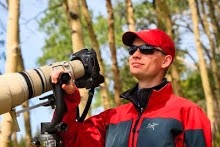
- Place you left hand on top of the lens, roughly over the center of the tripod. Your left hand should be resting gently, not applying any real force, as it is simply in place to absorb vibrations as they travel through the system. (I do not recommend using a bean bag in place of your hand)
- Grip the camera securely in your right hand; but you do not need to put it in a death grip. (Your right hand becomes another contact point to absorb vibrations)
- Press your shooting eye firmly against the cameras eyecup. I personally use a larger more comfortable eyecup on my Canon 7D, as it is the camera I use most often with my long lenses. (Your eye and face become another contact point to absorb vibrations)
- Calm your breathing, relax, and focus. This should also help to slow your heart rate, especially when those incredible and exciting situations arise.
- Keep your finger on the shutter release, and simply roll your finger to trigger the camera. If your finger is floating over the shutter release you will likely hit or poke at the shutter release causing vibrations, and potentially a shift in your framing. (Just like squeezing the trigger when shooting a gun or bow)
- Get out there and practice, use your camera in this manner often (ideally I would say daily). The biggest reason I know my camera, lenses, and other equipment so well is because I take several thousand photographs each month. If you don't have "good" local shooting just get out and shoot something, think about it like you would going out to exercise to stay in shape; but call it camera shape.
- Be sure to dress for the conditions. If you are cold and shivering your photographs will show it.
- Be sure your tripod is the right height for you. If you are standing be sure you can stand tall. If you are sitting be sure you can sit comfortably. (If you are not comfortable and balanced you will not be able to fully control your camera)
- Relax, I believe that most everything in life is at its best when you can relax.
- Breath, like relaxation remembering to breath is key. Holding your breath is rarely a good idea.
- Balance is critical, both for you and your camera/lens on the tripod.
- If you can not master the finger roll, use a cable release.
- If your hands are not on the camera use mirror lock up, or live view as a "modern" mirror lockup.
- Image stabilization is good, and always getting better; but you can help it out. Follow this advice and remember to give your IS/VR time to figure out what it should be doing
- Know your image stabilization. Does your lens/camera know when it is on a tripod, and what do you need to do when it is?
- Stay out of the wind. For me nothing seems to shake me and my camera more than high wind, so I do all that I can to shield myself and my camera from it (when I can).
- Use a lens coat. Not that the coat has stabilizing properties; but I find my lens more comfortable to touch when it is covered with soft and temperate neoprene.
- The list goes on and on...
- Did I mention practice?
Happy Shooting




 Posts
Posts

